
- English
- 简体中文
- tiếng Việt
- Indonesia
- שפה עברית
- Hrvatski
- Malti
- lugha ya Kiswahili
- Hausa
- Монгол хэл
- O'zbek
- Հայերեն
- Español
- Português
- русский
- Français
- 日本語
- Deutsch
- Italiano
- Nederlands
- ภาษาไทย
- Polski
- 한국어
- Svenska
- magyar
- Malay
- বাংলা ভাষার
- Dansk
- Suomi
- हिन्दी
- Pilipino
- Türkçe
- Gaeilge
- العربية
- Norsk
- český
- ελληνικά
- український
- Javanese
- فارسی
- Burmese
- български
- ລາວ
- Azərbaycan
- Slovenský jazyk
- Lietuvos
- Eesti Keel
- Română
- Slovenski
- தமிழ்

Working principle of screw air compressor
Screw air compressors are indispensable equipment in our daily work and life, their importance reflected in their wide range of applications. We can find screw air compressors in many industries, including automobile manufacturing, electronics, food and beverage, chemical and pharmaceutical, metallurgy and power, and textile printing and dyeing. This article will introduce Geso screw air compressors, starting with their working principle and characteristics.
1. What is a screw air compressor?
Before introducing the working principle and characteristics of screw air compressors, let's first talk about what a screw air compressor is. A screw air compressor uses a high-efficiency pulley or shaft to rotate, driving the main unit to compress air. Air compression and cooling are achieved through methods such as oil spraying, self-lubricating materials, special coatings, or water lubrication. Air compressed with lubricating oil needs to undergo two stages of separation: coarse and fine, to separate the oil from the compressed air and obtain clean compressed air.
2. Working principle and workflow of screw air compressor
Intake process: As the core component of the screw air compressor, the main unit first needs to drive the rotor. When the main unit rotates from the tooth groove space of the rotor to the opening at the air inlet, its space is at its maximum, and outside air fills it at this time. When the near end of the rotor rotates away from the air inlet, the air in the tooth groove is sealed within the main unit, between the rotor and the casing. Thus, the intake process is completed. After the intake process ends, the compression process begins.
Compression process: At the end of the intake process, the main unit has a closed volume between the rotor tooth peaks and the casing. As the rotor angle changes, the volume decreases and forms a spiral shape that moves continuously. This is the compression process of a screw air compressor.
Oil injection process: During gas transportation, as the gas is continuously compressed, its volume decreases, and the pressure and temperature continuously increase. Simultaneously, lubricating oil, atomized due to the pressure difference, is injected into the compression chamber, serving to compress, reduce temperature, seal, and lubricate.
Exhaust process: When the closed tooth peaks of the rotor rotate to meet the exhaust port of the casing, the compressed air begins to be discharged until the mating surface of the tooth peaks and tooth grooves moves to the exhaust end face. At this point, the tooth groove space is zero, and the exhaust process is complete. The discharged compressed air enters the aftercooler for cooling, reducing the temperature and improving air quality.
At the same time, the other pair of tooth grooves of the master and slave rotors have rotated to the intake end, forming the maximum space and starting the intake process, thus starting a new compression cycle.
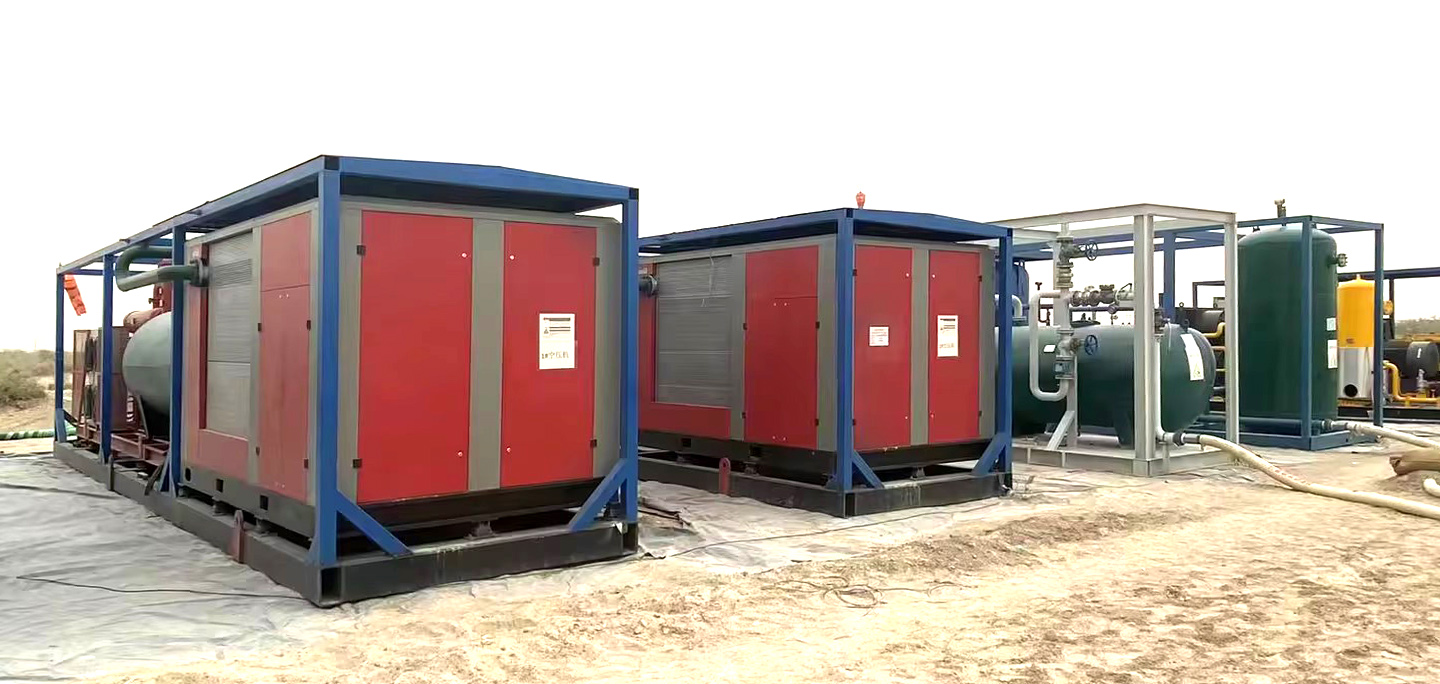
3. Main application industries of screw air compressors
Screw air compressors are widely used in many industries due to their high efficiency, energy saving, safety, and low noise. In the medical field, the compressed gas they produce can be used for medical applications and as pneumatic power for ventilators and other medical equipment. In mining, screw air compressors provide gas to drive mining equipment. In the construction industry, screw air compressors are mainly used to provide compressed air to drive various pneumatic tools and equipment, such as pneumatic nail guns. They are also a key piece of equipment in the manufacture of cement, steel, and other building materials.
In summary, screw air compressors are driven by an electric motor, causing a screw to rotate and create continuous compression chambers, thereby achieving the purpose of air compression. They offer advantages such as high efficiency, safety, reliability, and compact structure, and are widely used in industries such as automotive manufacturing, electronics, food and beverage, chemical and pharmaceutical, metallurgy, power generation, and textile printing and dyeing. In practical applications, screw air compressors can also provide compressed air for driving equipment in the mining and construction industries, and provide a power source for medical gases or pneumatic equipment in the medical field. Hopefully, this article has helped you better understand the working principle and applications of screw air compressors.